
Managed Services vs Staff Augmentation: Compare Costs, Control & Talent
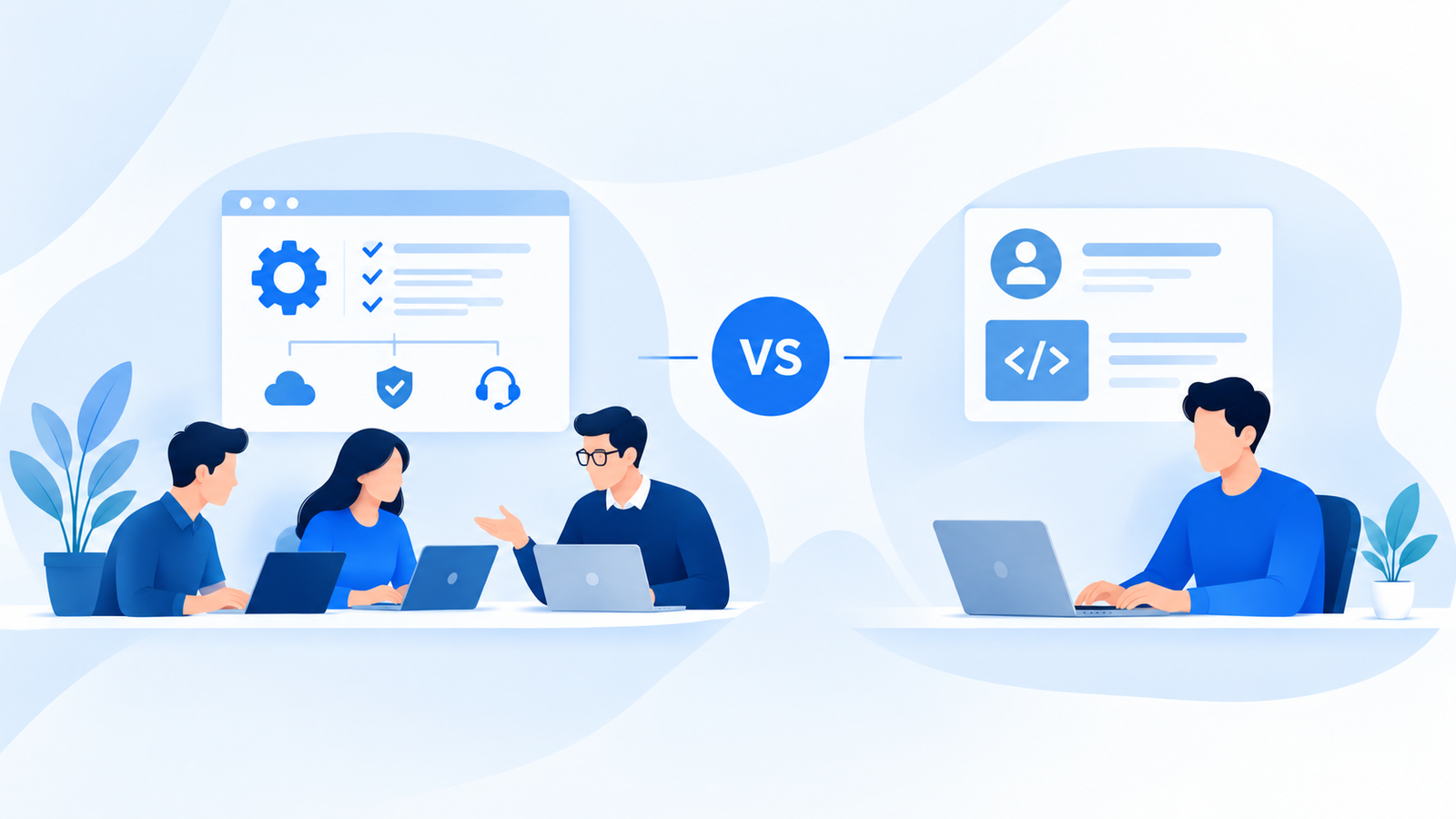
Your technical roadmap is slipping, and your internal engineering leadership is burning out. You know you need external help, but you are stuck between buying hours or buying outcomes. You’re not alone.
Global enterprise spending on IT services is projected to reach $1.87 trillion by 2026. The rise of digital transformation has made scaling through external partners a standard corporate tech strategy.
Yet many executives make the costly mistake of conflating managed services vs staff augmentation. Picking the wrong one can saddle your company with crushing management overhead or lock you into rigid contracts that stall agility.
Here is how you slice through the confusion and pick the right hiring model tailored to your project needs.
What is Managed Services?
An IT delivery model where a third-party provider takes ongoing responsibility for a defined technology function or service.
Instead of managing every operational task internally, an organization establishes a scope, service expectations, and performance requirements with the provider. The provider then manages delivery against agreed SLAs and KPIs.
Common Examples include:
- Cloud Infrastructure Management
- Network Management
- Cybersecurity Monitoring
- Application Maintenance
- IT Help Desk and Support
The IT managed services model is particularly relevant when an enterprise wants predictable operations without building and managing an entire internal function.
Simply put:
Define the Service → Transfer Operational Responsibility →Managed Against Agreed Outcome
What is Staff Augmentation?
Staff augmentation is a hiring model that allows a business to add external talent to their existing team. The business continues to own project direction, priorities, architecture, and day-to-day management. The external specialists provide the technical capacity or expertise required to execute the work.
For instance, ABC Enterprises is working on a new project and might augment its existing team with:
- Software Developers
- Quality Analysts
- Cybersecurity Professionals
- DevOps specialists
- QA Engineers
This makes IT staff augmentation services useful when the organization knows what skills it needs but does not want to make permanent hires for every requirement.
Staff Augmentation Types
This hiring model adapts to multiple frameworks depending on the requirements and budget of a business. Augment your staff based on skills or location preferences.
- Skill-based augmentation
You can add developers based on the skill type you require for your project. Whether it’s React, software, or AI staff augmentation, hire the right expert by assessing what you need.
- Location hiring
You can extend your team with onshore staff augmentation and bring domestic talent to your team for seamless collaboration. If you are looking to hire abroad talent for your team, include them through the offshore staff augmentation model.
Managed Services Model vs Staff Augmentation – What’s the Difference?
The staff augmentation and managed services model relate as complementary workforce strategies on opposite ends of the spectrum, where you either buy an individual or buy a fully managed outcome. However, both models differ from each other:
| Factor | Managed Services | Staff Augmentation |
|---|---|---|
| Primary Purpose | Outsource a defined IT function | Extend an existing team |
| Delivery Ownership | Service provider | Client |
| Day-to-day Management | Provider-led | Client-led |
| Control over resources | Generally indirect | Direct |
| Accountability | Provider owns agreed service outcomes | Client owns project outcomes |
| Talent Model | Provider’s delivery team | Dedicated external specialists |
| Scaling | Based on service scope | Based on team/resource needs |
| Pricing | Service, scope, SLA, or contract-based | Projects and capability gaps |
| Best Fit | Ongoing operational functions | Projects and capability gaps |
A useful distinction for CTOs and CIOs is:
Managed services transfer operational responsibility. Staff augmentation adds vetted talent.
IT Managed Services vs Staff Augmentation – Cost Comparison
It is crucial to have a clear understanding of the cost structure. The clearer you are about the cost, the more accurately you’ll prepare your budget. While both staff augmentation and managed IT services offer cost benefits over traditional hiring, they significantly differ in pricing.
| Factors | IT Staff Augmentation | Managed Services |
|---|---|---|
| Pricing | Hourly/monthly | Fixed or project-aligned |
| Junior Resource Cost | $25 – $45/hour | No junior rates apply; everything is included in team costing |
| Senior Resource Cost | $80 – $160/hr | Covered in team costing |
| Team Mix Costs | You pay a structured tally for every junior, mid, and senior stack. | You pay $120 – $300/user/month for an entire multi-tiered engineering pod |
| Minimum Commitment | Often 1 – 3 months | Typically 6 -12 months |
| Idle Time Cost | You pay 100% for downtime | Costs you $0 for downtime |
| Hidden Costs | Onboarding, management overhead | Transition/setup fees |
Control and Accountability
Control is one of the clearest differences between IT staff augmentation and managed services.
Staff Augmentation
The hiring model offers more control to businesses over the augmented staff as they work within your existing team.
The internal team can:
- Assign tasks directly
- Change priorities quickly
- Integrate specialists into existing workflows
- Manage technical decisions
This makes the model best suited for organizations that already have a project and engineering leadership but require additional technical capacity.
Managed IT Services
The service provider takes responsibility for an agreed service. Instead of managing individual resources, the client typically manages the relationship through:
- Service-level agreements
- KPIs
- Reporting
- Governance meetings
- Escalation process
For technology leaders, the question becomes obvious:
“Do they require more people to manage, or do you need a function managed by them?”
This makes the choice even clearer between the two.
Which Model is Suitable for Talent & Flexibility?
Staff augmentation, whether nearshore or offshore, this model is designed to provide better access to high-quality talent within or outside geographical boundaries. You can bring in specialized expertise to your existing team whenever your project needs it. This makes it useful for software development, testing, cloud modernization, and other technology initiatives.
For instance, a business can opt for software development augmentation when looking to add specialists like React, Python, Java, .NET, and more.
Managed services, however, are more focused on operational continuity.
The model is highly appropriate for businesses looking for a provider to continuously operate, monitor, support, or maintain a defined technology function.
When Should a Company Choose Which Hiring Model?
It is important to have a clear understanding of which engagement model precisely suits your project needs. Hire engineers strategically by picking the right hiring technique.
| Criteria | Staff Augmentation | IT Managed Services |
|---|---|---|
| Core Purpose | Allows you to temporarily add a skilled global workforce | Outsource responsibility for a complete function |
| Management Control | High | Lower |
| Pricing Structure | Hourly or monthly | Fixed or SLA-focused |
| Primary Risk Bearer | You own the complete risk | Your vendor owns the risk associated with |
| Ideal Timeline | Short sprint (1- 3 months) | Longer duration (6 – 12months +) |
When to Choose IT Staff Augmentation
- Your internal team already manages technology delivery
- You have a temporary capacity gap
- You need specialized technical expertise
- You want direct control over external developers
- Project requirements are frequently changing
- You need to scale an engineering team quickly
Choose Managed Services Model If
- A technology function requires continuous operation
- Internal teams do not have enough operational bandwidth
- The service can be clearly defined
- SLA and KPIs can establish measurable expectations
- The business wants an external provider to manage day-to-day operations
Can IT Staff Augmentation and Managed Services Model Work Together?
Yes. Enterprises do not necessarily need to choose one model for every technical requirement. A hybrid model can combine the strengths of both and allow a business to hire a dedicated team or developers, depending on the requirements.
For example:
| Internal IT leadership ↓ Managed Services Infrastructure, monitoring, support Staff Augmentation Development, modernization, specialist projects ↓ Internal Product & Engineering Teams |
This allows organizations to keep strategic and product ownership internally while using managed services for defined operational functions and augmented specialists for temporary capacity.
Conclusion
The difference between staff augmentation vs managed services comes down to the type of support your organization needs.
IT staff augmentation allows you to hire your requirement-related, niche expertise with complete flexibility. Whereas managed IT services provide end-to-end ownership and specialized expertise for complex or ongoing operations.
You can opt for the right hiring model that precisely suits your project and budget needs. Cost matters, but it shouldn’t be evaluated in isolation. Technology leaders should also consider control, talent accessibility, flexibility, and duration of the requirement.
FAQ’s
What is the difference between managed services and staff augmentation?
Managed services is basically a comprehensive outsourcing model in which an external partner is responsible for delivering specific business functions. Whereas the staff augmentation model allows a business to quickly integrate niche-specific specialized expertise temporarily.
Which is more cost-effective: managed services or staff augmentation?
Staff augmentation is usually more cost-effective for short-duration projects, while managed services is more cost-effective for long-term projects.
Which gives businesses more control over IT teams?
Staff augmentation generally provides more direct control to businesses because external experts work within the client’s existing team structure.
When should a company choose staff augmentation?
For projects that are good to cover in a short duration or when the company requires specific specialized expertise, the staff augmentation model is the precise fit.
When should a company choose managed services?
Managed services can suit organizations that need an external provider to continuously operate a defined IT function.
Can staff augmentation and managed services be used together?
Yes. Enterprises can use staff augmentation for specialized project work or additional engineering capacity while using managed services for ongoing operational functions.